
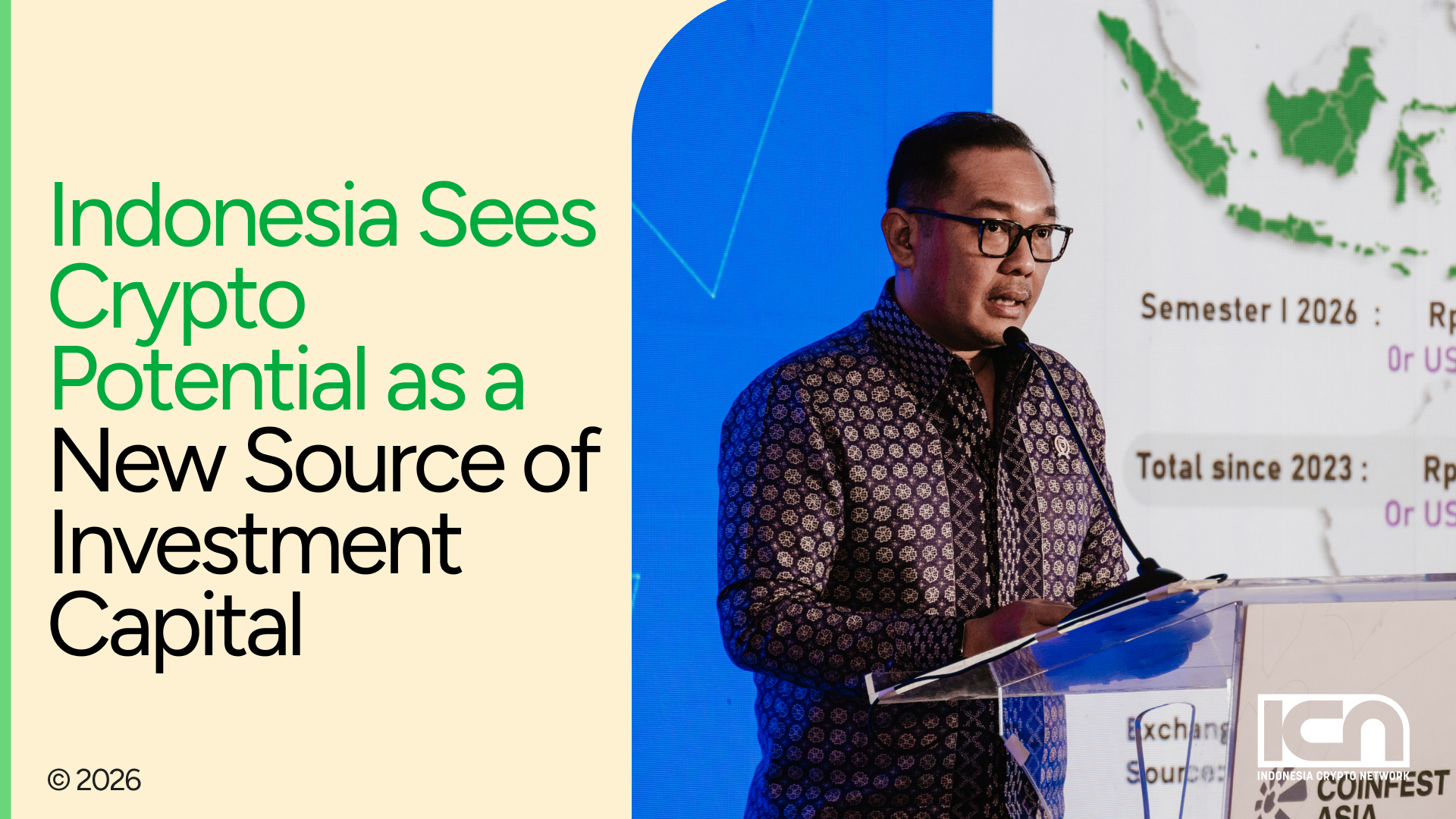
Indonesia’s Deputy Minister of Investment and Downstreaming/Deputy Head of the Investment Coordinating Board (BKPM), Todotua Pasaribu, said digital assets should not only be viewed from the perspective of adoption, but also for their potential to become a new source of capital for Indonesia’s economy.
Todotua shared the view while attending Coinfest Asia 2026 in Bali on August 20–21, 2026.
According to him, the growth of the crypto ecosystem presents an opportunity for the government to explore how capital within the digital asset sector can contribute to accelerating investment realization in Indonesia.
One mechanism considered capable of unlocking this potential is tokenization, which refers to the representation of assets or economic rights in the form of digital tokens.
“Tokenization is essentially a very easy way to unlock existing funding sources so they can be realized into investments,” Todotua said.
The government is currently exploring various new funding sources to support the national investment target of Rp13,032.8 trillion throughout 2025–2029. The target is part of efforts to drive Indonesia’s economic growth toward 8 percent by 2029.
Read more: Indonesia Opens Opportunity for Crypto to Connect with Real-World Investments
Tokenization as a Bridge for New Funding Sources
Todotua said tokenization could become one of the pathways connecting funding from the digital asset ecosystem with various investment opportunities in Indonesia.
He mentioned villas, hotels, and industrialization projects as examples of investments that could potentially be linked to such mechanisms.
Beyond tokenization, the development of regulatory sandboxes was also highlighted as part of the infrastructure that needs to be strengthened to ensure new funding sources can grow within a regulated framework.
This approach could complement existing funding channels, such as venture capital, asset management, and bank financing.
“What matters to us is how to accelerate investment realization. Investment realization must generate capital inflows into our country,” Todotua said.
According to a presentation from the Ministry of Investment, tokenization potential also extends to various types of assets and economic activities, including commodities, commercial cash flows, intellectual property, downstream products, and other real-world assets.
Through this mechanism, productive assets in Indonesia could potentially gain access to broader funding sources, including global investors.
Read more: OJK Prepares to Integrate Crypto into Indonesia’s Financial System
Blockchain Development Investment Begins to Grow
The push to develop Indonesia’s digital asset ecosystem comes amid increasing investment in blockchain technology development.
Based on the Indonesian Standard Industrial Classification (KBLI) 62193, which covers blockchain-based application development activities, investment realization in the first half of 2026 reached Rp71.38 billion.
The figure was more than three times higher than total investment realization throughout 2025, which stood at Rp20.75 billion.
Cumulatively since 2023, investment in this category has reached Rp131.9 billion.
Jakarta remains the center of blockchain development investment, contributing around 87.4 percent, while Bali contributed approximately 9.9 percent.
Todotua acknowledged that the figure remains relatively small compared with Indonesia’s overall investment landscape. However, the growth indicates that capital is beginning to flow into technology development that could support Indonesia’s digital economy.
Overall, Indonesia’s investment realization from January to June 2026 reached Rp1,010.6 trillion, growing 7.2 percent year-on-year.
The realization also created 1,448,862 jobs.
Government Seeks New Sources of Capital
Efforts to expand funding sources are also being pursued through the development of the Indonesia International Financial Center (PFII).
PFII is designed as an international financial ecosystem that can connect global capital with investment opportunities in Indonesia and the broader ASEAN region.
According to Todotua, the ecosystem is expected to attract international banks, asset management firms, fintech companies, family offices, professional service providers, and digital finance players.
For Bali, the development of PFII is also expected to expand the region’s economic foundation, which has historically relied heavily on tourism.
Financial services, technology, digital services, professional services, and innovation are among the sectors with significant potential for further development.
Todotua emphasized that the government will continue monitoring industry developments while encouraging the creation of an ecosystem that can contribute to economic growth.